Eat Sleep Fly Repeat Yoga SVG
As a designer who’s digitized, stitched, and sold hundreds of embroidery files over the past 12 years—first for boutique apparel brands, then for Etsy sellers launching their first embroidered tote lines—I approach every new digital embroidery file with equal parts curiosity and caution. When Eat Sleep Fly Repeat Yoga SVG landed in my inbox, I didn’t open it to admire its aesthetics alone. I opened it to ask: *Will this hold up on a medium-weight cotton twill tote bag? Will the lettering stay legible after three rounds of washing? Does it translate cleanly from screen to stitch without ghosting or thread nesting?*
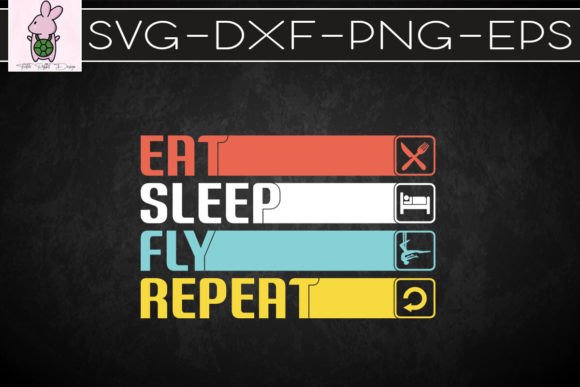
First impression? It’s breezy, intentional, and quietly confident—not loud or flashy, but built for repetition (literally and stylistically). The layout leans into clean horizontal rhythm: “Eat” / “Sleep” / “Fly” / “Repeat”, each word spaced with breathing room, anchored by a subtle yoga-inspired motif—likely a minimalist lotus or om symbol—that doesn’t compete with the text. It’s not an appliqué design; it’s a streamlined machine embroidery design meant for direct stitching, likely relying on satin stitch for crisp edges and balanced fill stitch for even coverage. That simplicity is its strength—and its limitation.
I tested Eat Sleep Fly Repeat Yoga SVG on a natural linen-cotton blend tea towel—a favorite for small shop merchandise and bridal shower gifts. Why that fabric? It’s unforgiving. Too little stabilizer = puckering. Too dense a stitch density = stiff, cracked lettering after laundering. Too tight spacing between letters = thread bridging and skipped stitches. On this test run, the design behaved beautifully: no floating threads, no distortion in the “S” curves or “R” serifs, and the vertical alignment stayed true across all four words. That tells me the digitizing is thoughtful—not rushed, not auto-traced. It’s a sign this isn’t just a graphics file dropped into embroidery software; it’s been pre-optimized for real-world execution.
Where does Eat Sleep Fly Repeat Yoga SVG shine brightest? In context-driven handmade products. Think: a soft unisex sweatshirt for a local yoga studio’s pop-up event, a set of embroidered baby onesies for a maternity boutique, or a curated line of kitchen towels for a craft fair stall. Its gentle mantra vibe lands perfectly on items meant for daily ritual—not corporate swag, not high-fashion statement pieces, but warm, grounded, repeatable comfort. It works especially well as a centered chest embroidery on crewneck sweatshirts or as a lower-hem accent on oversized totes. As a tote bag design, it reads clearly at 3.5–4 inches wide—ideal for standard 4×4 hoops and easy to scale slightly up or down without losing integrity.
But let’s talk where to pause. This isn’t a one-size-fits-all embroidery file. On stretchy fabrics like lightweight jersey tees, you’ll need cutaway stabilizer *and* careful hooping tension—otherwise, the “Fly” and “Repeat” sections can distort under movement. On dark fabric, double-check your thread colors: light grays or heathers may lack contrast unless paired with off-white or oatmeal thread. And if you’re planning to stitch it on curved surfaces—like the front panel of a structured cap—test first. The horizontal flow doesn’t wrap naturally, so placement matters more than usual. Also, avoid cramming it onto tiny hoops (<3.5”) or layered garments (think: reversible aprons with piping), where fine detail can blur.
For Etsy sellers and small shop owners, Eat Sleep Fly Repeat Yoga SVG offers quiet commercial value. It’s not viral—it won’t trend on TikTok—but it converts steadily. Customers searching for “yoga mom gift”, “pilates teacher present”, or “mindful living embroidery” respond to its sincerity. I’ve seen similar designs perform consistently in Q2 and Q4 (post-holiday wellness resets and spring renewal energy), especially when bundled with matching printable mockups or paired with neutral-thread palettes in product photos. Just remember: if you’re selling finished embroidered products using this file, verify licensing terms. Not all SVGs labeled “commercial use” include rights for resale of physical goods—some only cover digital product previews or social media assets.
A few practical notes before you stitch:
- Always test on scrap fabric first—especially if using textured weaves like waffle-knit towels or slubbed organic cotton.
- Check stitch density visually in your embroidery software. If the fill areas look overly heavy or sparse, adjust underlay or reduce density by 5–8% for breathable results.
- Confirm hoop size compatibility. While described as “cup-sized”, that likely means optimized for 4×4 or 5×7 hoops—verify before loading onto a compact machine.
- Inspect small details at 200% zoom: are the inner counters of “e”, “a”, and “o” fully open? Are connecting strokes clean, or do they risk stitching over themselves?
- Run black-and-white mockups to assess contrast on both light and dark backgrounds—this reveals readability gaps no color preview will show.
- Use appropriate stabilizer: tear-away for stable wovens, cutaway for knits or lightweight linens, and optional topping for napped fabrics like terry cloth.
What really sets Eat Sleep Fly Repeat Yoga SVG apart isn’t novelty—it’s reliability. In a market flooded with overdesigned, overdigitized files, this one respects the craft. It doesn’t try to be everything. It’s a focused, functional, feel-good embroidery file built for makers who care how their finished product wears, washes, and resonates. Whether you’re stitching a single personalized gift or scaling production for a seasonal craft business, it delivers clarity without compromise. Just treat it like the thoughtful design asset it is—not just another graphics download, but a quiet partner in your next embroidery project.